Polished plaster for kitchens
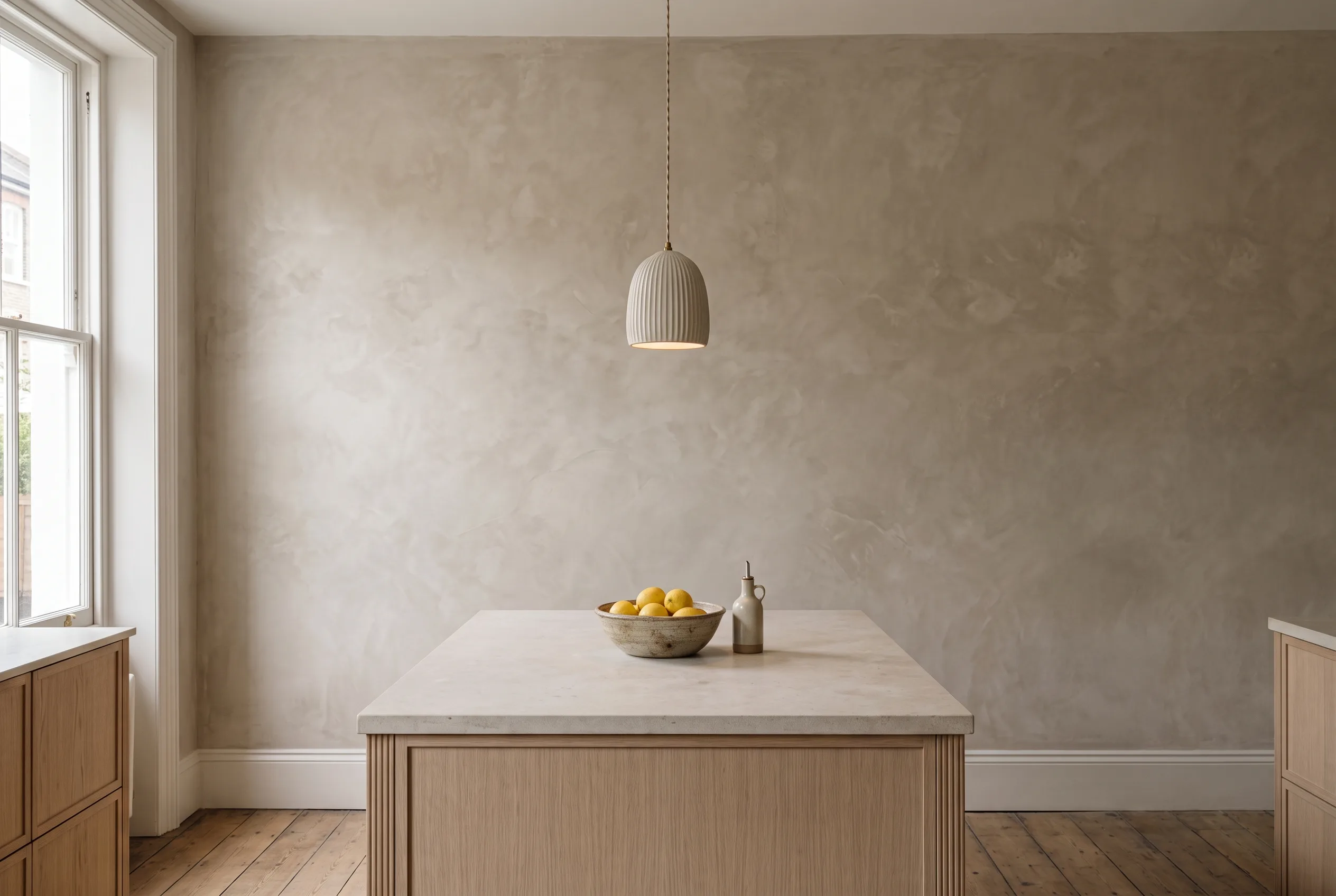
Polished plaster in a kitchen softens a room full of hard, straight surfaces, and a sealed finish on the right walls wipes clean like paint.
It works best on the island wall, a plastered hood and the walls around a dining area, and needs more thought directly behind a hob or sink.
Where it works
The walls that gain most are the ones you see from the rest of the room: the wall behind an island, the wall a dining table sits against, and the chimney-style hood that has become a feature in its own right. None of these take direct splashes of fat or water.
A plastered hood is built as a frame and boarded first, usually by the kitchen fitter, then finished to match or contrast with the walls. It needs the same care at the board joints as any boarded wall.
Behind the hob and the sink
Directly behind a hob, a finish meets heat and grease every day. Behind a sink, it meets water. A sealed finish can cope with some of this, but glass, stone or tile is often the more practical choice in the few centimetres that take the worst of it, with plaster carrying on around them.
The hob manufacturer's distances to surrounding materials apply whatever the finish, and they are checked before anything is recommended.
Keeping it clean
In a kitchen the finish is sealed, so that it wipes clean with a soft damp cloth and mild soap. Scourers and strong degreasers damage the surface. A slightly deeper colour or a finish with some movement hides everyday marks better than a flat pale one.
Finishes that suit kitchens
Marmorino is a natural fit: warm, calm and not too shiny under bright kitchen lights. A polished Venetian finish adds more depth on an island wall. See finishes compared.
Common questions
Can I have polished plaster as a splashback?
Behind a hob or sink it takes heat, grease and water daily. A sealed finish can cope with some of that, but glass, stone or tile is often more practical in that narrow strip. It is decided case by case.
When should the plaster go on in a kitchen refit?
After the dusty and wet work is done, and in coordination with the fitter, so the units and worktops are protected and the edges finish cleanly.

Start with a conversation about your space
Tell us about the room, the surface and the look you are after. Rough measurements are enough to begin, and we will talk you through suitable finishes and the next steps.